



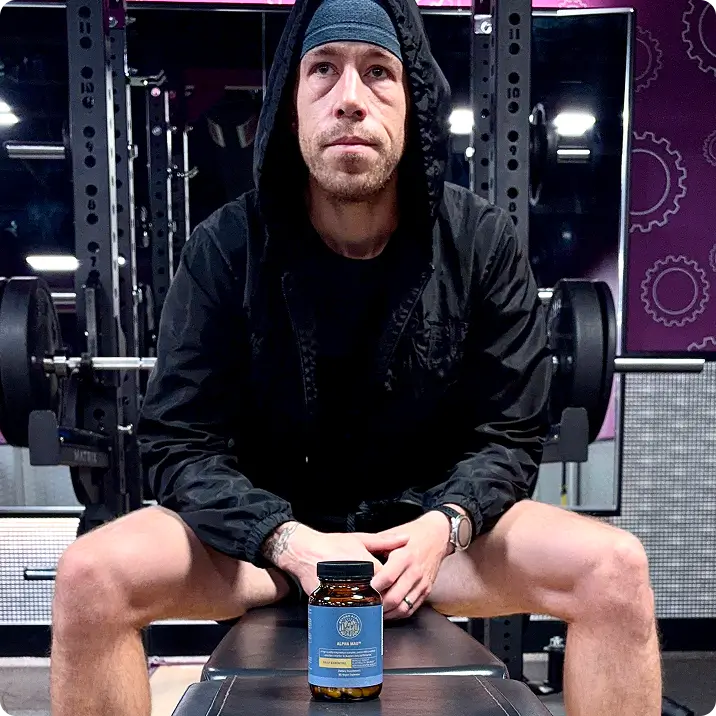
Two capsules, about an hour before bed. No special timing, no food requirements. Just two capsules and you are done.
Date: Apr 13, 2026
The Science of Staying Sharp After 35
A look at testosterone, brain performance and the mineral most men aren’t getting enough of.
Mental fog? You’re not imagining it.
The slower recall, the mid-afternoon slump, the feeling that your brain just doesn’t fire like it used to, these aren’t signs of decline; they’re signs that something real is shifting inside your body.
For many men, it all starts with one overlooked mineral.

Why do men feel brain fog after 35?

Brain fog in men over thirty-five is closely linked to declining magnesium levels. Research suggests that up to nearly half of the US population consumed less magnesium than required from food(6), a mineral involved in more than 300 processes in the body, including energy production, nerve signalling, muscle function and hormone regulation. When these systems are running below optimal, cognitive sharpness can suffer.
A 2024 systematic review and meta-analysis in Advances in Nutrition(1) found a U-shaped association between serum magnesium and the risk of cognitive impairment and dementia, with the lowest risk around 0.85 mmol/L, a level many men are below and will never know, because standard blood panels don’t include magnesium unless specifically requested.
A six-year study published in the European Journal of Nutrition(2) found that men with higher magnesium intake at baseline showed significantly lower odds of cognitive impairment at follow-up, particularly across processing speed and memory. The association was held for over six years. That’s not background noise.
The hidden cost of modern stress

Here is the honest truth about life after thirty-five: the demands go up and the recovery reserves go down.
More financial pressure, more responsibility at work and a family depending on you to hold it together. Nights that are shorter than they should be and mornings that start before you are ready for them.
Chronic, low-grade stress is now a defining feature of working-age life and stress depletes magnesium at an accelerated rate. A systematic review on magnesium and stress(3) found that lower magnesium status can be associated with higher subjective stress. The more pressure you carry, the faster your body burns through it and the less you have, the harder it becomes to cope.
There is also a food supply problem as decades of intensive farming have measurably reduced the mineral content of the soil. The spinach, nuts and wholegrains you eat today most likely deliver significantly less magnesium than the same foods did a generation ago.
Eating well is no longer enough on its own.
How does magnesium affect SHBG and free testosterone?

Magnesium deficiency is associated with elevated sex hormone-binding globulin (SHBG), a protein that binds to testosterone in the bloodstream and limits how much your body can actually use. Restoring adequate magnesium may help bring SHBG back toward normal levels, making more of your free testosterone available to reach your muscles, your brain and your tissues.
Testosterone is not just about muscle and libido. Research suggests it is involved in cognitive function, including areas such as focus, working memory and mental resilience(5). After thirty-five, your levels may decline roughly 1-2% per year.
It is important to understand that SHBG can determine how much of your testosterone your body can use, thus impacting your free testosterone. How? SHBG binds to testosterone in the bloodstream, which can make it difficult for it to reach your muscles, your brain or your tissues. In fact, your blood test can come back normal while the amount your body is actively using is far lower than it should be.
In one study(4), men given a daily dose of magnesium saw meaningful increases in both free and total testosterone.
What is the best magnesium for men’s cognitive function?

Common magnesium oxide, the kind lining most pharmacy shelves, absorbs at roughly 4%. A 500mg capsule delivers around 20mg to your body and the rest passes through unused. But it’s important to realize that not all forms work the same way:
Magnesium Glycinate: chelated to glycine for high absorption; calms the stress response and supports restful, restorative sleep
Magnesium Malate: feeds directly into your cells’ energy cycle; associated with significantly reduced afternoon fatigue
Magnesium Citrate: one of the fastest-absorbing forms available; rapidly replaces what daily stress burns through
Magnesium Gluconate: replenishes via the gut lining without the laxative effect other forms are notorious for
The form matters enormously.
Most supplements use one, but to address multiple systems such as energy, nerve function, sleep quality and hormonal balance, you need several working together.
What are the effects of magnesium optimisation in men?

When you restore magnesium to adequate levels, in forms your body can actually absorb, the effects tend to follow a predictable sequence.
Sleep improves first. You stop lying awake with your mind running and you fall asleep like clockwork and wake up feeling rested, not just ‘okay’.
Sustained energy follows. Not a caffeine hit that crashes an hour later, but the steady output that gets you through the afternoon without hitting a wall.
Mental clarity comes next. The fog lifts and decisions feel less effortful. You’re sharper in meetings, more present with your family and less drained by the end of the day. This is not stimulation; it is correction, with your body returning to the baseline it was designed to operate at.
Can magnesium help with confidence in men over 35?


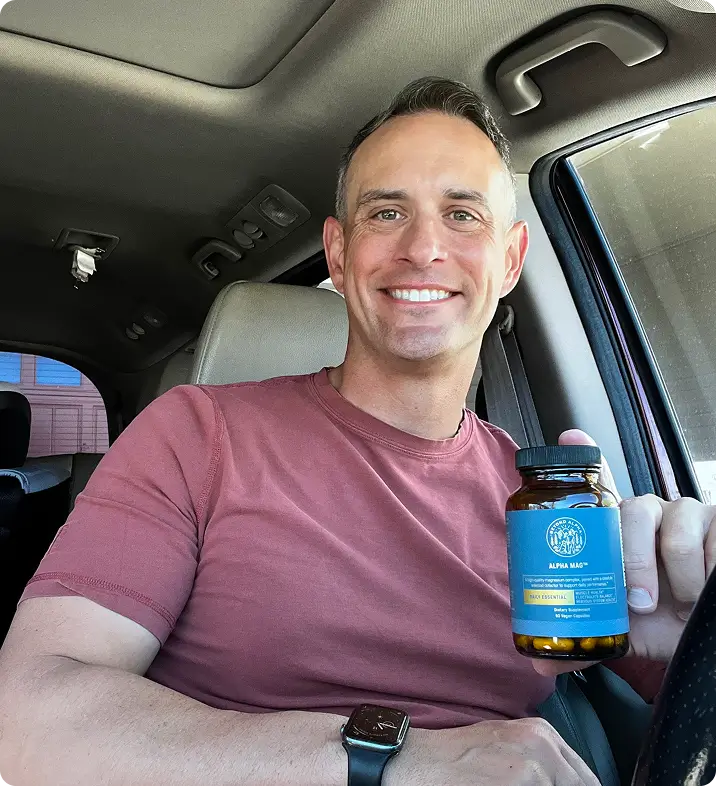
Beyond Alpha’s Alpha Mag™ is a 7-in-1 magnesium formula designed specifically for this problem, men who are running below optimal, often without realising it.
It combines seven distinct forms of magnesium, each targeting a specific function, alongside Boron as an absorption enhancer and AQUAMIN Mg, a trace-mineral-rich source drawn from North Atlantic seawater. Every ingredient is dosed at clinically relevant levels and triple-tested before it ships.
- Two capsules before bed
- The restorative work happens overnight
- You wake up with something your body may not have had in years
The bottom line: how to stay mentally sharper after thirty-five

Staying mentally sharp after thirty-five is not about pushing harder; it is about giving your body what it needs to function as it was designed to.
For the large majority of men, magnesium deficiency is a silent drag on energy, cognition and hormonal health and most will never know it is there. Restoring it does not need to be a complicated fix, but it does require the right forms, at the right doses, taken consistently.
Alpha Mag™ was built to help men wake up clear, focused, and ready to take the day back.
Take back yours.
Frequently Asked Questions
How do I take Alpha Mag™?
I tried magnesium before and felt nothing. Why would this be any different?
Almost every man who says that tried magnesium oxide, the form that lines the shelves at most pharmacies. It absorbs at roughly 4%, which means a 500mg capsule delivers around 20mg to your body. The rest goes nowhere. That is not a magnesium problem. That is a cheap ingredients problem. Alpha Mag™ uses seven bioavailable forms, each chosen because it actually absorbs and does a specific job. If your previous supplement was magnesium oxide, you have not really tried magnesium yet.
Are there any side effects?
Magnesium is one of the most well-tolerated minerals available. Your kidneys handle any excess naturally. The chelated forms in this formula, particularly glycinate and gluconate, are specifically chosen for their gentle effect on the stomach. There are no stimulants, no hormones and nothing that conflicts with standard supplements. If you are taking diuretics, antibiotics or acid reflux medication, check with your doctor first as magnesium can interact with those.
My doctor ran bloodwork and said I was fine. So why would I be deficient?
Because the standard blood panel tests the wrong thing. It measures magnesium floating in your blood, which represents less than 1% of your body’s total magnesium. The other 99% lives inside your cells, in bone, muscle and tissue. Those levels never show up on a routine panel. Your serum reading can look perfectly normal while your cells are running on empty. Fine bloodwork and actual deficiency are not mutually exclusive.
I eat well. Shouldn’t that be enough?
It would have been enough fifty years ago. Decades of intensive farming have stripped a significant amount of magnesium from the soil, meaning the vegetables and wholegrains you eat today contain measurably less than the same foods did a generation ago. Even a clean diet often falls short of the 375mg daily requirement. Add in stress and any medications that accelerate magnesium excretion, and the gap widens further. Diet helps, but it is no longer sufficient on its own.
Am I too old for this to make a difference?
It actually works the other way. The older you are, the more likely you are to be deficient, and the more noticeable the correction tends to be. Magnesium absorption naturally decreases with age, kidney efficiency drops and medication use increases. You are not broken. You are depleted. And depleted is fixable.
How long does a bottle last?
Each bottle contains 60 capsules, giving you 30 days at two capsules per day. A minimum of 60 days of consistent use is recommended to feel the full effect, which is why most men choose to stock up on two or three bottles upfront.
References
1. Chen, F. et al. (2024). Magnesium and Cognitive Health in Adults: A Systematic Review and Meta-Analysis. Advances in Nutrition. https://pubmed.ncbi.nlm.nih.gov/39009081/
2. Tao, M.H. et al. (2024). Cross-sectional and longitudinal associations of magnesium intake and cognition. European Journal of Nutrition. https://pubmed.ncbi.nlm.nih.gov/39240315/
3. Boyle, N. et al. (2017). The Effects of Magnesium Supplementation on Subjective Anxiety and Stress. Nutrients. https://pubmed.ncbi.nlm.nih.gov/28445426/
4. Cinar, V. et al. (2010). Effects of magnesium supplementation on testosterone levels of athletes and sedentary subjects at rest and after exhaustion. Biological Trace Element Research, 140(1), 18–23. https://pubmed.ncbi.nlm.nih.gov/20352370/
5. Beauchet, O. (2006). Testosterone and cognitive function: current clinical evidence of a relationship. European Journal of Endocrinology, 155(6), 773–781. https://pubmed.ncbi.nlm.nih.gov/17132744/
6. Rosanoff A, Weaver CM, Rude RK. Suboptimal magnesium status in the United States: are the health consequences underestimated? Nutr Rev. 2012;70(3):153‑164. doi:10.1093/nutrit/nur076 https://pubmed.ncbi.nlm.nih.gov/22364157/ .